
Introduction
In the first blogpost in this series, the focus was on why the Domain Name System (DNS) is a critical but often overlooked component of technical SEO.
DNS is positioned as the infrastructure layer that supports website speed, availability, accessibility, and crawl efficiency, and as a key factor in how search engines evaluate reliability and user experience.
Building on that foundation, this second part moves from configuration and theory to real-world impact.
This second blogpost examines how DNS performance affects SEO in practice, beginning with its role in loading speed and search performance. From the first DNS lookup to page rendering and crawl behaviour, DNS performance directly shapes how both users and search engines experience a website.

How DNS affects SEO in practice
We have previously explained what you should consider configure and how. Now we will explore why those choices matter for SEO.
Loading time and search performance
DNS Speed and its impact on loading time
Website speed is one of the most influential factors in both user experience and search engine optimisation, and DNS plays a critical role in this equation.
Before any website content can begin loading in a visitor’s browser, a DNS lookup must first translate the domain name into an IP address. This makes DNS resolution the very first step in the loading process—and any delay at this stage affects everything that follows.
How DNS resolution affects page load performance
DNS resolution time directly contributes to overall page loading speed.
Even small delays measured in milliseconds can accumulate, increasing the time it takes for a page to become visible and interactive. Fast DNS responses reduce latency and improve key performance metrics such as Time to First Byte (TTFB), allowing servers to start delivering content more quickly. Since search engines prioritise fast-loading websites, efficient DNS resolution supports better rankings by improving both performance signals and user satisfaction.
In contrast, slow or inefficient DNS services can significantly increase loading times. Relying solely on basic DNS services from a domain registrar often results in longer resolution times, which can negatively impact page speed scores, engagement rates, and bounce rates. As loading times increase, users are more likely to abandon a site—behaviour that search engines interpret as a sign of poor quality.

Why every millisecond matters for SEO
In competitive search environments, every millisecond counts.
Research consistently shows that even small delays in page load time can lead to reduced engagement and lower conversion rates. Faster websites provide a smoother browsing experience, encouraging users to stay longer, interact more, and return in the future. These behavioural signals reinforce a site’s relevance and quality in the eyes of search engines, contributing to stronger SEO performance.
Optimising DNS for faster load times
Optimising DNS speed starts with choosing a reliable DNS provider with a globally distributed infrastructure and fast query response times.
Providers with geographically dispersed points of presence can route users to the closest available server, reducing latency for international audiences. Techniques such as DNS caching further improve performance by storing previously resolved domain information, minimising repeated lookups and accelerating access for returning visitors.
Reducing unnecessary DNS lookups is another effective optimisation strategy. Each external resource—such as third-party scripts, fonts, or images—requires an additional DNS query. By consolidating resources, limiting third-party dependencies, and following efficient coding practices, websites can streamline DNS resolution and reduce overall load times.
Speed, user experience, and search rankings
Fast-loading websites deliver a better user experience, which is a core ranking factor for modern search engines. DNS contributes to this by ensuring efficient traffic routing, quick server connections, and reliable access to content.
When DNS performance is optimised, websites load faster, respond more quickly, and remain consistently available creating the conditions search engines reward with higher visibility in search results.
DNS availability and accessibility: a critical foundation for SEO
Why availability and accessibility matter for search visibility
Availability and accessibility are essential prerequisites for search engine visibility. Regardless of how strong a website’s content or optimisation efforts may be, they deliver little value if users or search engine crawlers cannot reliably reach the site. DNS plays a decisive role in this foundation by ensuring that domain names consistently resolve to the correct servers, enabling uninterrupted access for both humans and bots.
Search engines closely monitor website availability. When crawlers attempt to access a site and encounter DNS errors or outages, indexing is delayed or interrupted. Newly published or updated pages may not be discovered in time, and repeated accessibility issues can signal unreliability. Over time, this can negatively influence how search engines assess a site’s quality, stability, and ranking potential.

The SEO impact of DNS downtime
DNS downtime is particularly harmful because it makes an entire website unreachable. Causes range from misconfigured records and server failures to network issues and cyberattacks such as Distributed Denial of Service (DDoS). Even short disruptions can have measurable consequences, including lost traffic, reduced crawl frequency, and declining search visibility.
From a user perspective, encountering an unavailable website often leads to immediate abandonment, increased bounce rates, and reduced trust. These negative engagement signals further reinforce the SEO impact, as search engines favour websites that are consistently accessible and responsive.
Building reliability through DNS infrastructure
Ensuring continuous accessibility requires a resilient DNS infrastructure. High-quality DNS providers rely on multiple name servers, geographically distributed points of presence (PoPs), and Anycast routing to answer queries efficiently and reliably. This distribution reduces dependency on single servers and ensures that users are directed to the nearest available location, improving availability on a global scale.
For organisations with international audiences or high traffic volumes, a DNS provider with a broad network footprint is especially important. A limited or unicast-based setup can increase response times and raise the risk of service disruptions.
Redundancy, failover, and continuous monitoring
Redundancy is a cornerstone of DNS availability. DNS failover mechanisms automatically redirect traffic to backup servers if a primary endpoint becomes unavailable, maintaining service continuity during outages or maintenance events. This prevents prolonged downtime that could otherwise harm SEO and user trust.
Real-time DNS monitoring complements failover by detecting issues early. Continuous monitoring enables faster response times, reduces the duration of incidents, and helps maintain consistent accessibility for both users and search engine crawlers.

Security as a component of accessibility
Availability is closely linked to security. DNS infrastructure is a common target for attacks designed to disrupt access or redirect users to malicious destinations. Protective measures such as DDoS mitigation, multiple redundant DNS servers, and DNS Security Extensions (DNSSEC) help safeguard DNS integrity.
DNSSEC adds cryptographic validation to DNS responses, preventing manipulation such as cache poisoning. By enhancing trust and reliability at the DNS level, these security measures support long-term accessibility and reinforce the signals search engines associate with dependable websites.
Managing DNS changes without disruptions
Accessibility can also be affected by routine operational changes, such as updating an IP address or modifying DNS records. When these changes are planned carefully—by adjusting TTL values in advance, scheduling updates during low-traffic periods, and monitoring propagation—they do not need to impact SEO.
Poorly managed DNS changes, however, can result in propagation delays or temporary inaccessibility, leading to traffic loss and reduced visibility. Proper DNS management ensures continuity during transitions and protects both user experience and search performance.
How DNS performance shapes SEO results
DNS performance determines how search engines and users experience your website — in real time.
Well-configured DNS enables strong performance. Strong DNS performance supports sustainable SEO results.
Diagram 1. summarizes how various DNS performance factors impacts SEO.
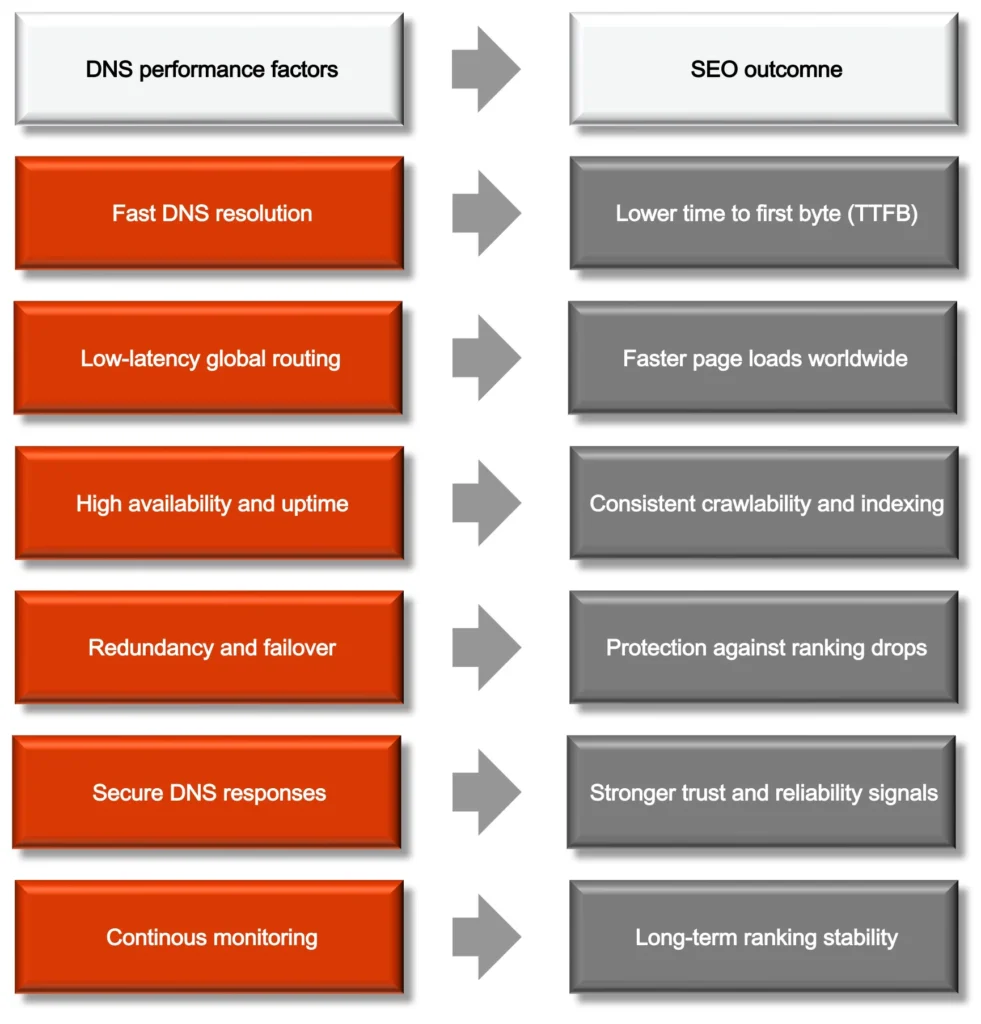
Domain names and their impact on SEO
Why domain names matter for SEO
A domain name is far more than just a website address. It is a fundamental part of how users and search engines discover, interpret, and trust a website.
The domain you choose shapes first impressions, supports brand identity, and influences several technical and behavioural SEO signals. While a strong domain alone will not secure top rankings, it provides an essential foundation for long-term visibility and credibility.
How domain names influence search rankings
Search engines use domain-related signals to better understand a website’s relevance and quality. A clear, logical domain and URL structure makes it easier for search engines to crawl and index content efficiently. Confusing or overly complex structures, on the other hand, can hinder discoverability and dilute authority.
Including keywords in a domain can still be helpful when done in moderation. Although keywords in domains are no longer a major ranking factor, they can quickly communicate topical relevance to users and search engines. Overuse, however, risks appearing unnatural and may harm trust.
In most cases, a strong, memorable brand name delivers greater long-term SEO value than aggressive keyword optimisation.
The role of top-level domains (TLDs)
Top-level domains (TLDs), such as .com, .org, or country-specific extensions like .co.uk or .de, influence how search engines and users perceive a website. Country-code TLDs clearly signal geographic relevance and often perform better in local search results. For businesses focused on a specific market, this can be a strategic advantage.
Generic TLDs, including .com, .net, and newer extensions like .tech or .blog, are well suited for international audiences. While TLDs themselves do not directly improve rankings, widely recognised extensions tend to inspire greater user confidence and higher click-through rates, indirectly supporting SEO performance.
Domain structure, URLs, and subdomains
The structure of a domain and its URLs also affects SEO.
Clean, readable URLs help search engines understand content hierarchy and topic relevance. Subdomains can be useful for separating distinct sections of a website, but excessive or poorly planned use may fragment authority and confuse search engines if relationships between pages are unclear.
A well-structured domain supports both usability and crawl efficiency, reinforcing overall SEO performance.
Domain security and trust signals
Security is an important ranking consideration. Websites using HTTPS are favoured by search engines because they provide a safer experience for users. Implementing SSL certificates and maintaining a secure domain environment enhances trust and aligns with modern SEO standards.
Domain age and history also influence trust. Established domains with a clean record, consistent ownership, and quality backlinks often perform better than newly registered domains.
Conversely, domains with a history of spam or penalties may struggle to regain credibility, making background checks essential when acquiring or reusing a domain.
Why domain length matters
Domain length has a direct impact on usability, credibility, and SEO-related user signals.
Shorter domains are easier to remember, quicker to type, and less prone to errors. They also tend to look more professional, which improves trust and click-through rates from search results.
Long, complex domain names can appear untrustworthy, reduce memorability, and increase the likelihood of typos. While keywords can be helpful, they should never come at the expense of clarity.
In practice, short to medium-length domains strike the best balance between branding, usability, and SEO.

Choosing the right domain for your target market
The ideal domain depends on your business goals and audience.
Local businesses benefit from country-specific TLDs, while global brands typically perform best with generic extensions. Organisations and institutions may gain authority from specialised TLDs such as .org, while modern or niche projects can use newer extensions if branding is clear and consistent.
Domain choices should also account for future growth, including international expansion and brand protection.
Managing your domain for long-term SEO
SEO impact does not end once a domain is registered. Ongoing management is critical. Renewing domains on time, maintaining redirects during changes, monitoring click-through rates, and keeping registration details accurate all help preserve trust and ranking potential.
A well-chosen and well-managed domain becomes a long-term asset. By prioritising clarity, trust, and strategic alignment, businesses can ensure their domain supports SEO performance, brand recognition, and sustainable growth.
Conclusion
DNS performance shapes search visibility
DNS performance directly affects how users and search engines experience a website.
From the initial DNS lookup to page loading and ongoing accessibility, DNS influences core SEO signals such as speed, crawlability, reliability, and trust. Slow resolution times, instability, or misconfigurations can translate into reduced visibility, weaker engagement, and declining rankings.
Availability, reliability, and trust
Downtime, resolution errors, or poorly managed DNS changes can prevent search engines from crawling and indexing content effectively. For users, unreliable access leads to abandonment and reduced trust—signals that search engines associate with lower-quality experiences.
Redundancy, failover mechanisms, and security measures therefore play a critical role in protecting both visibility and credibility.

Domain names as SEO signals
Domain names reinforce DNS performance by shaping both technical behaviour and user perception.
Clear domain structures, appropriate TLD selection, secure configurations, and long-term domain management support crawl efficiency, trust signals, and click-through behaviour.
While no single domain factor guarantees strong rankings, together they influence how relevance and authority are interpreted.
DNS as an ongoing SEO responsibility
DNS should not be treated as a background utility. It is an active component of technical SEO that requires continuous monitoring, proactive optimisation, and resilient infrastructure.
When DNS is managed with the same strategic focus as content and on-page optimisation, it reduces risk, protects rankings, and supports long-term SEO stability and growth.